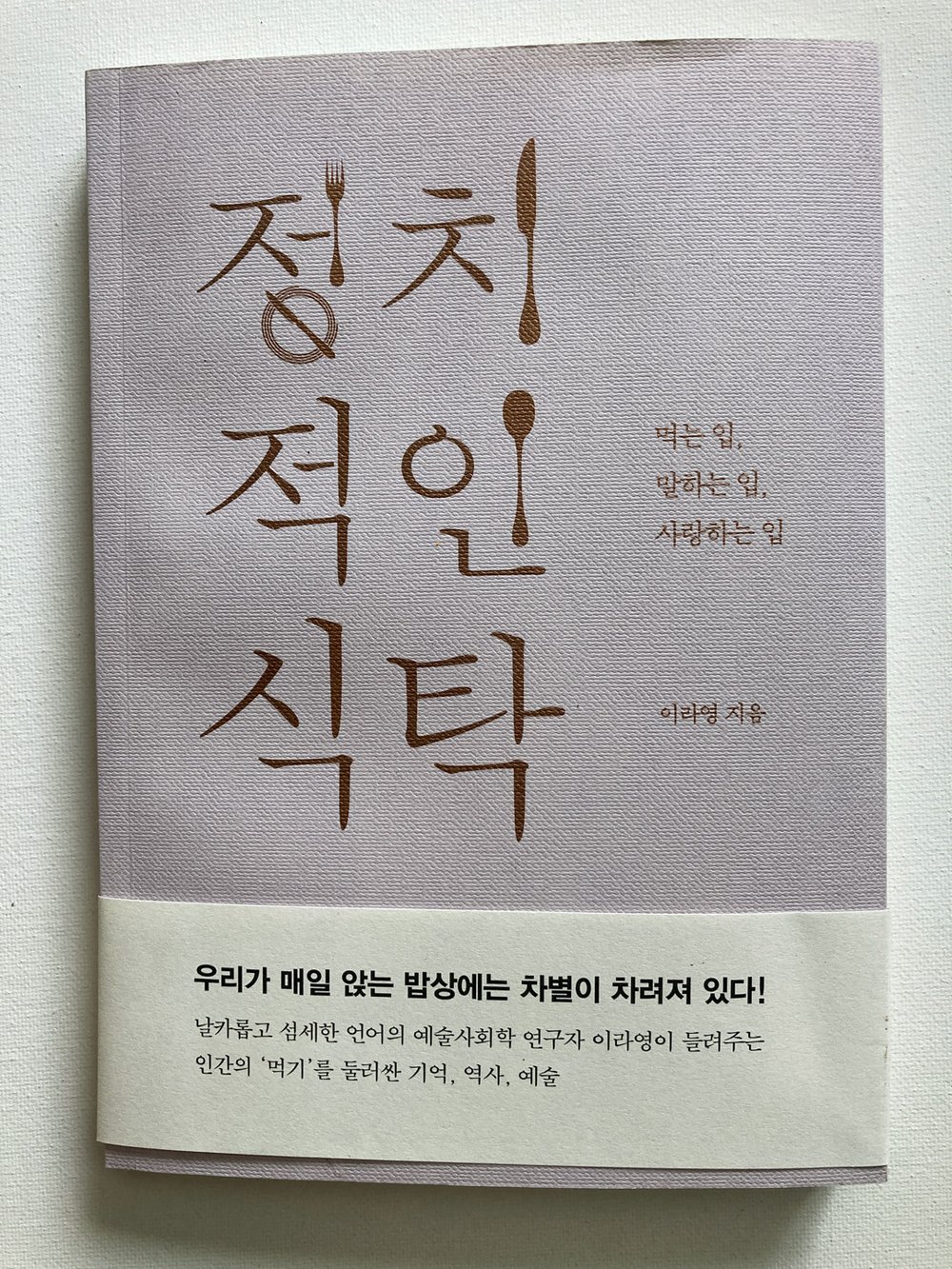
- Book
- 정치적인 식탁
The Political Dining Table (English translation of the title) - Author
- Lee Ra-young (이라영)
- Publisher
- Dongnyok (동녘), Paju, South Korea
- Published
- September 2019, 256 pages
- Language
- Korean
- Dana’s painting
- Chicken Soup, oil on canvas, 14 × 18 in., 2017 (page 38)
- Chapter
- Chapter 1, “Women Who Eat” (먹는 여자)
- Credit
- “p.38: © Dana Ellyn” (page 256)
About the book
정치적인 식탁 is a 256-page book by Lee Ra-young (이라영), published in South Korea in September 2019 by Dongnyok (동녘). The title translates as The Political Dining Table; no English title is printed on the book. It looks at everyday eating through feminism, history and art, and is illustrated with artworks and photographs. Dana Ellyn’s painting Chicken Soup (oil on canvas, 14 × 18 in., 2017) appears in color on page 38, in Chapter 1, “Women Who Eat.” The book’s credits page lists “p.38: © Dana Ellyn.”
What the cover says
먹는 입, 말하는 입, 사랑하는 입
The mouth that eats, the mouth that speaks, the mouth that loves
우리가 매일 앉는 밥상에는 차별이 차려져 있다!
Discrimination is served at the table we sit down to every day!
날카롭고 섬세한 언어의 예술사회학 연구자 이라영이 들려주는 인간의 ‘먹기’를 둘러싼 기억, 역사, 예술
Memory, history and art surrounding human ‘eating,’ told by Lee Ra-young, a sociologist of art with a sharp and subtle way with words
Page 38 in English
다나 일라인, 〈치킨 수프Chicken Soup〉(2017). 물감과 붓 등 미술재료에도 동물로 만들지 않은 ‘비건’이 있다. 다나 일라인은 비건 작가로 작품의 재료와 소재 모두 이러한 비건주의를 적용한다.
Dana Ellyn, Chicken Soup (2017). Art materials such as paints and brushes also come in ‘vegan’ versions, made without animals. As a vegan artist, Dana Ellyn applies this veganism to both the materials and the subject matter of her work.
The text on pages 38–39
That a laboring man needs meat to keep up his strength is a long-standing common belief. Another, similar belief is the superstition that eating the meat of a powerful animal makes you stronger in proportion. Hidden in the myths of patriarchal culture is the belief that meat makes men strong, and that masculine traits are formed by eating this manly food. …… The superstition that men are strong, that men need to be strong, and that men therefore need meat still remains.
There were people who called December 10, 2016, the day the National Assembly passed the impeachment motion, and March 10, 2017, the day the Constitutional Court ruled on the impeachment, “the day to catch the chicken.” What was it they caught? The words “herbivore man” and “carnivore woman” are popular because men are rarely likened to plant-eating animals, or women to meat-eating ones. Men are usually likened to the carnivores at the top of the food chain. From something as simple as the order in which the meat on the table is eaten, to something as broad as the status of rulers of the world, power is handed to men as if by nature. A “table of meat” is a kind of ruler’s table that women offer to men. “A plate of greens” often stands for a woman’s half-hearted table: What kind of side dishes are these? What do you do at home all day! Now that chicken breast has become more popular, things have changed a little, but among older people there is still a pecking order for the drumsticks. Many older people think a son comes before a daughter, and a husband before a wife, when it comes to the drumstick.
In Han Kang’s The Vegetarian, the meal that so disappointed Yeong-hye’s husband, lettuce wraps with soybean paste and a clear seaweed soup made without beef or even clams, is one I often eat when I am alone. Yeong-hye’s vegetarianism is not only a change in her diet. It turns into a change in all of her relationships. Once she stops eating meat, Yeong-hye no longer has sex with her husband, and no longer helps him get ready for work. “Not eating” meat also becomes a way of standing up to her father. Resisting the violence of the father who forces meat into Yeong-hye’s mouth …
The first paragraph is a quotation in the book, marked with footnote 4. The text continues on page 40.